I’ve been using Semrush for over five years — across my own affiliate sites and client projects. And one thing I keep noticing: most feature breakdowns online either read like a copy-paste of the official docs or go so surface-level that they don’t actually help you decide anything.
This isn’t that. I’m going to walk through the features that genuinely move the needle, flag the ones that are more marketing than substance, and tell you upfront what Semrush isn’t great at. By the end, you should know exactly whether it fits your workflow.
This post contains affiliate links. If you purchase through our links, we may earn a small commission at no extra cost to you. Thank you for your support!What Semrush Actually Is (And Isn’t)
Most people land on Semrush looking for a keyword research tool. That’s fair — keyword research is where it shines. But calling it just an SEO tool undersells what it’s become.
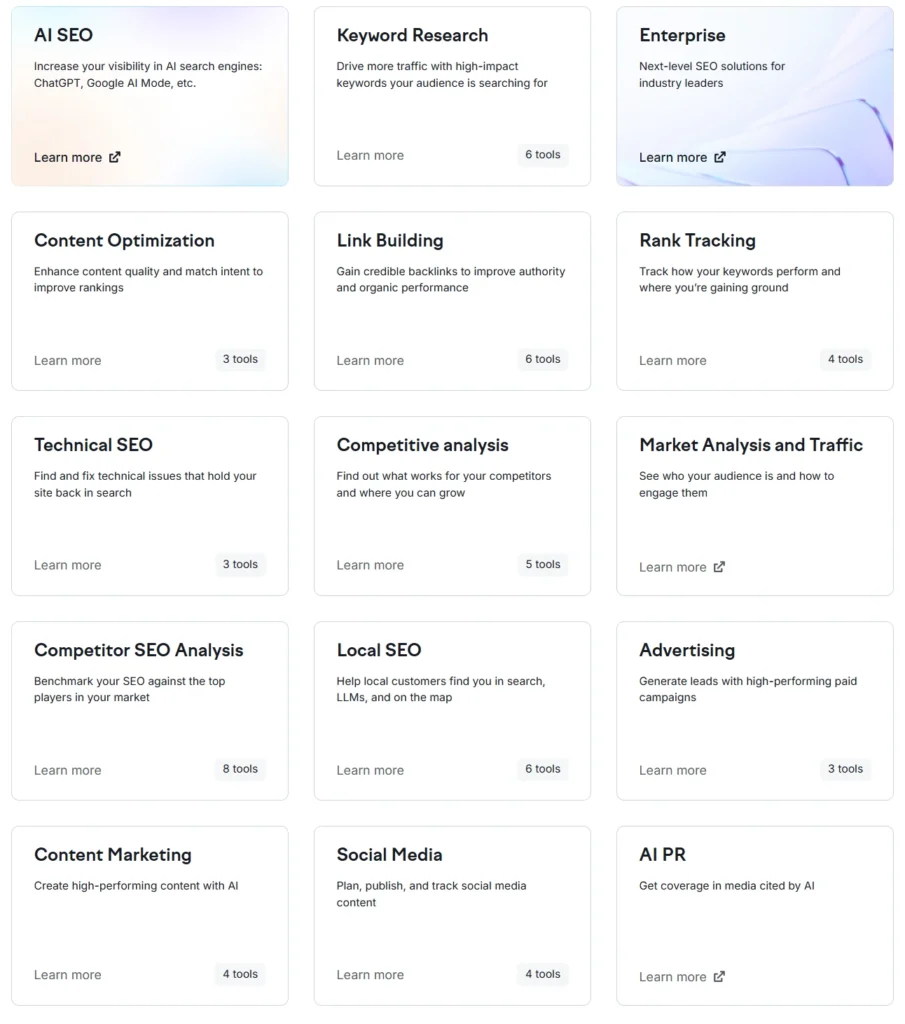
Semrush now covers traditional SEO, PPC research, content optimization, link building, local SEO, social media, and — most recently — AI visibility tracking. It’s a full digital marketing platform that happens to be excellent at SEO.
That said, this breadth is also where beginners sometimes get lost. The dashboard can feel like walking into a control room. There are 55+ tools across multiple toolkits. Knowing which ones actually matter for your goals is the real skill.
The Features That Actually Deliver Value
Keyword Research: Still the Core Strength
The Keyword Magic Tool is genuinely one of the best in the industry. You enter a seed keyword and it surfaces thousands of variations — with search volume, keyword difficulty, CPC, search intent, and SERP features all in one view.
What makes it useful in practice is the filtering system. You can filter by intent (informational, commercial, navigational, transactional), exclude terms, set difficulty ceilings, and drill into question-based variations. If you’re building topical clusters for a niche blog, this workflow saves hours.
On the Pro plan (SEO Classic), you get 10,000 results per report with 250 keyword metric updates per month. Guru bumps that to 30,000 results and 1,000 updates. For a single-site blogger, the Pro limits are fine. For client SEO work across multiple projects, you’ll feel the Guru limits more quickly.
One thing competitors often don’t mention: Semrush keyword data is primarily Google-based. If you’re chasing visibility on Bing or AI-native search engines, the traditional keyword tools don’t cover that — that’s what the newer AI Visibility toolkit handles separately.
Competitor Research: Where It Earns Its Price
This is honestly where I get the most value. The Domain Overview report shows you any website’s estimated organic traffic, top keywords, backlink count, and traffic trend — in under 30 seconds.
When I’m doing niche research for a new affiliate project, I run a competitor’s domain through Semrush and immediately see which pages drive most of their traffic, what keywords they rank for that I’m not targeting, and where their backlink profile has gaps I can exploit. That intelligence used to take hours of manual research.
The Organic Research and Keyword Gap tools together are particularly powerful. Keyword Gap lets you compare up to five domains simultaneously and surface keywords your competitors rank for that you don’t. For a client project I was running last year, this single report gave us a 60+ keyword opportunity list that directly shaped the content plan.
Site Audit: Practical, Not Just Decorative
A lot of SEO tools include site audits that produce scary-looking reports full of “issues” that don’t actually impact rankings. Semrush’s Site Audit is more useful than most because it prioritizes by impact and explains the fix in plain language.
The AI Search Site Audit is now included across all plans — it checks how your site performs from an AI search crawler perspective, not just traditional Googlebot. This matters more than it did two years ago.
On the Pro plan, you can crawl 100,000 pages/month. Guru goes to 300,000. JavaScript rendering (needed for React/Vue-based sites) is locked behind Guru and above — that’s worth knowing if you’re auditing modern frontend-heavy sites.
From a web development perspective, the audit flags render-blocking scripts, Core Web Vitals issues, and internal linking gaps. I’ve used it on client WordPress sites to identify JS/CSS bloat that wasn’t obvious from the WordPress dashboard.
Position Tracking: Daily Rankings Without the Manual Work
Position Tracking does exactly what it says — monitors your target keywords daily across specific locations and devices. The Pro plan tracks 500 keywords, the Guru plan tracks 1,500, and the Business plan tracks 5,000.
The part most reviews gloss over: the Targets per monitored website limit. Pro users get 1 target per website, which means you can track one location/device combination. Guru increases that to 10 targets — which matters if you’re doing local SEO across multiple cities or need to separate desktop and mobile ranking data.
Keyword Cannibalization reports are Guru+ only. If you’re managing a large content site and suspecting pages are competing against each other in SERPs, this report identifies the problem fast.
Backlink Analysis and Link Building
Semrush’s backlink database is one of the largest available. The Backlink Analytics tool shows referring domains, authority scores, anchor text distribution, and new/lost link trends.
The Link Building Tool goes further — it’s essentially a CRM for outreach. You can find prospects, save them to a campaign, track outreach status, and monitor which links you’ve acquired. This is not a common feature at this price point. Most tools just show you backlink data — Semrush helps you act on it.
Backlinks are available on all SEO Classic plans, including Pro.
Content Optimization Tools
The SEO Writing Assistant integrates with Google Docs and WordPress via a plugin. It checks readability, keyword usage, tone of voice, and semantic coverage in real time. For content teams, this reduces editing cycles.
Content optimization tools are available on Guru+ in the SEO Classic tier. If you’re on Pro and doing heavy content production, this is the most likely feature that’ll make you consider upgrading.
AI Visibility: The Real 2026 Differentiator
This is where Semrush is ahead of most competitors right now.
The AI Visibility Toolkit tracks how your brand and content appear in AI-generated responses — across platforms like ChatGPT, Google AI Overview, and Gemini. You can see how often your brand gets cited, what prompts surface your content, and how you compare to competitors in AI search share.
Every plan (both SEO Classic and Semrush One) includes the AI Visibility overview, competitor research, and prompt research. But the depth varies. The Semrush One plans are specifically built with AI visibility as a first-class feature — with dedicated AI brand performance domains, daily prompt tracking, and AI-ready Site Audit.
Importantly: there is no free trial for the AI Visibility Toolkit as a standalone feature — you access it through your plan.
Semrush Plans: Two Tracks, One Decision
This is something competitors rarely explain properly. Semrush currently runs two separate plan structures, and confusing them leads to bad purchasing decisions.
SEO Classic Plans (Traditional SEO Focus)
| Pro | Guru | Business | |
|---|---|---|---|
| Monthly Price | $139.95/mo | $249.95/mo | $499.95/mo |
| Annual Price | $117.33/mo | $208.33/mo | $416.66/mo |
| Websites to Monitor | 5 | 15 | 40 |
| Keywords to Track Daily | 500 | 1,500 | 5,000 |
| Pages to Crawl/Month | 100,000 | 300,000 | 1,000,000 |
| Historical Data | ✗ | ✓ | ✓ |
| JavaScript Rendering | ✗ | ✓ | ✓ |
| API Access | ✗ | ✗ | ✓ |
| Results Per Report | 10,000 | 30,000 | 50,000 |
| Looker Studio Integration | ✗ | ✓ | ✓ |
| Best For | Solo bloggers, freelancers | Growing sites, agencies | Large agencies, enterprises |
Annual billing saves up to 17% on all plans.
Semrush One Plans (Traditional SEO + AI Visibility + GEO)
Semrush One is the newer plan structure positioned for users who need both traditional SEO and AI search optimization under one subscription.
| Starter | Pro+ | Advanced | |
|---|---|---|---|
| Monthly Price | $199/mo | $299/mo | $549/mo |
| Annual Price | $165.17/mo | $248.17/mo | $455.67/mo |
| Websites to Monitor | 5 | 15 | 40 |
| Keywords to Track Daily | 500 | 1,500 | 5,000 |
| AI Prompts to Track Daily | 50 | 100 | 200 |
| AI Visibility Reports/Day | 300 | 300 | 300 |
| Historical Data | ✗ | ✓ | ✓ |
| API Access | ✗ | ✗ | ✓ |
| MCP Access | ✓ | ✓ | ✓ |
| Best For | AI-first beginners | Growing brands with AI focus | Power users needing full stack |
Both Starter and Pro+ offer a free trial. Advanced requires a direct subscription or a custom plan.
Which track should you pick? If your primary need is traditional SEO and content work, the SEO Classic plans give you more feature maturity per dollar. If you’re serious about tracking your brand’s presence in AI-generated search results — ChatGPT citations, Google AI Overviews — then Semrush One is the better fit.
Add-Ons Worth Knowing About
Semrush offers paid add-ons on top of any plan:
- Additional Users — Starting at $45/mo (SEO Classic) — each plan includes only 1 user seat by default
- AI Visibility Toolkit for Additional Users — $99/user/mo
- Lead Generation — $90/mo — includes branded Agency Partners profile, Semrush verified badge, and 1,000 outreach credits in Lead Finder
- Base Report — $10/mo — automated reports pulling data from 20+ Semrush tools with GA/GSC integration, PDF export
- Pro Report — $20/mo — adds 20+ external integrations, delivery scheduling, white-labeling, and AI-generated summaries
The single-user-seat default is the most common frustration I see from agency users. If you’re bringing in a second team member, factor $45+/mo into your real cost upfront.
Honest Pros and Cons
Pros
- The keyword research database is genuinely one of the largest available, with strong intent filtering
- Competitor intelligence tools save hours of manual research — Domain Overview alone is worth the subscription for active SEO practitioners
- Backlink database + CRM-style outreach tool in one place — rare at this tier
- AI Visibility Toolkit is ahead of competitors in tracking AI search presence
- Site Audit is practical and prioritizes real impact over fear-inducing issue counts
- Free trial available on Pro, Guru, Semrush One Starter, and Pro+ plans
- MCP access included — useful for integrating Semrush data into AI workflow tools
Cons
- Only 1 user seat per plan — even the $499.95/mo Business plan includes just one user
- Keyword data covers Google primarily — Bing and other search engines are not tracked
- Historical data locked behind Guru ($208.33/mo annually) — not available on Pro
- JavaScript rendering in Site Audit requires Guru or above
- Add-on costs stack up quickly for agencies: extra users, Lead Generation, Pro Reports
- The sheer number of tools (55+) can overwhelm beginners — the learning curve is real
Who Should Use Semrush (And Who Shouldn’t)
Use it if you:
- Run a content-driven site or affiliate blog and need serious keyword research depth
- Do competitive SEO analysis regularly — whether for your own sites or clients
- Want to track how your content and brand appear in AI-generated search results
- Manage link-building campaigns and want outreach organized in one place
Skip it if you:
- Are just starting and running a single blog — Google Search Console + a free Ubersuggest account covers early-stage needs
- Need keyword data for Bing, DuckDuckGo, or non-Google search engines as primary targets
- Need 3+ user seats regularly — the additional seat costs make it expensive fast
- Are on a tight budget and only need rank tracking — cheaper tools like AccuRanker do that one thing at a lower price
Semrush vs. The Alternatives
Not everyone needs Semrush’s full toolkit. Here’s how it stacks up against three commonly considered alternatives — with real numbers, not vague comparisons.
| Feature | Semrush Pro (Classic) | Ahrefs Lite | Mangools Basic | Ubersuggest Individual |
|---|---|---|---|---|
| Starting Price (Monthly) | $139.95/mo | $129/mo | $30.50/mo | ₹1,135/mo |
| Starting Price (Annual) | $117.33/mo | $108/mo | $18.85/mo | ₹630.83/mo |
| Keyword Tracking | 500 keywords | 750 keywords | 200 keywords | 125 keywords/domain |
| Backlink Data | Excellent | Excellent | 100k/mo | 2,000 backlinks |
| Site Audit Crawl | 100,000 pages/mo | 100,000 credits/mo | 20 req/24h | 1,000 pages/domain/week |
| AI Visibility Tracking | Dedicated toolkit | Brand Radar AI (add-on from $198/mo) | AI Search Watcher PRO (bundled) | Basic — 10 prompts/month (free version only) |
| Historical Data | Guru+ only | 6 months on Lite | Not available | Not available |
| Content Optimization | Guru+ only | Content Kit add-on ($99/mo) | Not available | Not available |
| PPC / Ad Data | Yes | No | No | No |
| Free Trial | Yes | No (Ahrefs Free available) | 48-hour refund guarantee | Yes |
| User Seats (Base Plan) | 1 | 1 | No extra seats | 1 |
| Best For | Full-stack SEO + AI visibility | Technical SEO + backlink depth | Budget bloggers, beginners | Very early-stage solo projects |
Post-comparison breakdown:
Ahrefs Lite at $108/mo (annual) is the closest real competitor to Semrush Pro. Its backlink crawler is arguably stronger, and the Keywords Explorer is genuinely excellent. But it doesn’t have PPC data, content optimization tools, or a comparable AI visibility feature built in — Brand Radar AI is a separate purchase starting from $198/mo. For pure technical SEO and link analysis work, Ahrefs is a legitimate alternative. For content-heavy affiliate sites that also want ad intelligence and AI search tracking, Semrush pulls ahead.
Mangools Basic at $18.85/mo (annual) is a completely different tier. It bundles AI Search Watcher PRO — which tracks 500 prompts across multiple LLMs, including ChatGPT, Gemini, and more — at a price point that makes Semrush look expensive. The tradeoff is depth: keyword research is limited to 100 requests per 24 hours, backlink data is thin at 100k/mo, and there’s no site audit in the traditional sense, no historical data, and no PPC tooling. For a beginner blogger doing basic keyword research and AI visibility monitoring on a tight budget, Mangools is worth a look at this price. For serious SEO work, it runs out of room fast.
Ubersuggest is priced in INR, which makes it accessible for Indian users — the Individual plan starts at ₹630.83/mo on annual billing. It covers basic rank tracking, keyword suggestions (20,000/month on Individual), and site audit (1,000 pages/week). The AI search visibility feature is limited to 10 prompts/month on the free version — the full AI add-on costs extra. It’s the lightest of these three alternatives, and the data depth shows. It makes sense as a starting point or for someone running a single site on a tight budget, but most users outgrow it quickly. Check current pricing here: Ubersuggest.
The clear call: For anyone running multiple content sites, doing client SEO, or needing PPC + content + AI visibility in one place — Semrush is still the strongest all-rounder at this price range. Ahrefs is the alternative if backlinks are your primary obsession. Mangools is the smart budget pick if AI visibility monitoring matters to you, but Semrush’s price doesn’t fit yet.
What to Do After Subscribing
First thing: don’t try to use everything at once. Semrush has 55+ tools, and the fastest way to waste your first week is opening everything in a tab spiral.
Start here:
- Run a Domain Overview on your own site — establish a baseline. Traffic trend, top pages, backlink count. Takes two minutes.
- Set up Position Tracking for your 10–20 most important keywords. This gives you weekly movement data without manual rank checking.
- Run a Site Audit — fix the critical and high-priority issues first. Ignore anything marked “notice” for now.
- Do a Keyword Gap analysis against your top 2–3 competitors. Export the list and build your next quarter’s content plan from it.
- Set up the AI Visibility overview if you’re on Semrush One — add your brand name and key product/service terms as tracked prompts.
The mistake most people make is treating Semrush as a dashboard to check rather than a research tool to act on. The data is only valuable when it changes what you publish or fix.
Frequently Asked Questions
Is Semrush free to use?
Semrush doesn’t offer a permanently free plan, but the Pro and Guru plans (SEO Classic), and Starter and Pro+ plans (Semrush One) all come with a free trial. You can test core features before committing to a paid subscription.
Which Semrush plan is best for a beginner blogger?
The SEO Classic Pro plan at $117.33/mo (billed annually) covers keyword research, site audit for up to 5 sites, position tracking for 500 keywords, and backlink data — enough for most solo bloggers. If you need content optimization tools or historical keyword data, Guru is the next step up.
Does Semrush track AI search results like ChatGPT or Google AI Overviews?
Yes. Semrush has a dedicated AI Visibility Toolkit that tracks how your brand and content appear in AI-generated responses across ChatGPT, Google AI Overview, and Gemini. This feature is available across both SEO Classic and Semrush One plans, but Semrush One is purpose-built around it.
What’s the difference between Semrush One and SEO Classic plans?
SEO Classic plans (Pro, Guru, Business) focus on traditional SEO — keyword research, backlinks, site audit, and rank tracking. Semrush One (Starter, Pro+, Advanced) bundles traditional SEO with AI visibility tracking and GEO features at a higher price point. Choose SEO Classic for core SEO work; choose Semrush One if AI search tracking is a priority.
Can you use Semrush for free keyword research without signing up?
Semrush allows limited free searches before requiring an account. The results are capped and don’t include full data. You’ll need at least a free trial account to access meaningful keyword research reports.
Is historical data important — and which plan includes it?
Historical data lets you see how a keyword’s search volume or a domain’s rankings have changed over time. It’s useful for spotting seasonal trends and analyzing long-term competitor momentum. It’s only available on Guru ($208.33/mo annually) and above in the SEO Classic tier, and on Pro+ ($248.17/mo annually) and above in Semrush One.
Every Semrush plan — at every tier — includes just one user seat by default. Additional users cost $45/mo each on SEO Classic plans. This is the most common pain point for small agencies. Factor this in before choosing a plan.
Final Verdict
Semrush earns its reputation. The keyword research depth, competitor intelligence, and backlink tooling alone justify the cost for anyone doing serious SEO work. The AI Visibility features put it meaningfully ahead of most alternatives for tracking brand presence in AI search, which matters more in 2026 than it did two years ago.
The single-user-seat default is a real limitation for teams, and the plan structure (two separate tracks, multiple add-ons) can be confusing at first. But once you understand which track fits your goals, the value-to-feature ratio is strong.
For solo bloggers and content-driven affiliate sites: start with the SEO Classic Pro plan’s free trial. For growing agencies or anyone building AI search visibility alongside traditional SEO, Semrush One Starter is worth a look.