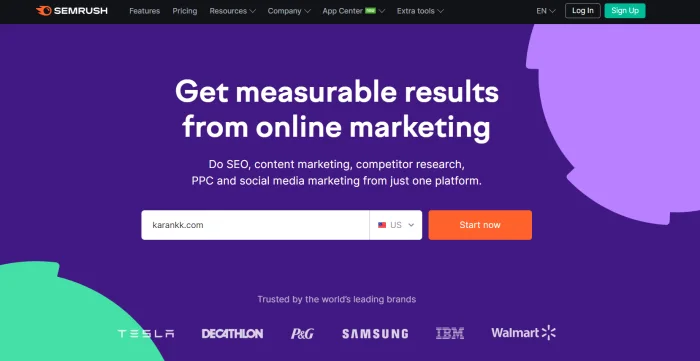
If you’ve looked at Semrush’s pricing page and immediately felt the sting — you’re not alone. At $139.95/month just to get started, it’s one of the priciest tools in SEO. And that’s the discounted annual rate.
The question most people are really asking isn’t just “why so expensive” — it’s “is it actually worth this much, or am I overpaying for something I can get cheaper?”
Having used Semrush for 5+ years across my own affiliate sites and client projects, here’s the honest answer.
The Short Answer
Semrush is expensive because it combines 55+ tools under one subscription — keyword research, backlink analysis, site audit, rank tracking, competitor intelligence, content optimization, and now AI search visibility — all backed by one of the largest SEO databases in the industry. You’re not paying for one tool. You’re paying for a platform that replaces 6–8 separate subscriptions.
That said, “worth it” depends entirely on who you are and how you use it.
This post contains affiliate links. If you purchase through our links, we may earn a small commission at no extra cost to you. Thank you for your support!What You’re Actually Paying For
Most people see the price tag and assume they’re just paying for a keyword tool. That’s not what Semrush is.
The platform covers three broad areas:
Traditional SEO — keyword research, site audit, backlink analysis, position tracking, competitor intelligence, and on-page SEO recommendations. This alone would cost $80–150/month if you cobbled it together from individual tools.
Content Marketing — keyword cannibalization detection, topic research, content optimization, and historical data for trend analysis. Features like these are locked behind paywalls on most platforms, even at higher price points.
AI Search Visibility — this is the newer addition, most competitors haven’t caught onto yet. Semrush now tracks how your brand appears in AI-generated search results (ChatGPT, Google AI Overviews, Perplexity). Even the entry-level plan lets you monitor 50 prompts daily and track 300 AI visibility reports per day.
That third layer — AI search visibility — is genuinely new territory. No other mainstream SEO tool at this price point offers it out of the box.
The Actual Price Breakdown (2026)
Semrush currently runs two plan families. This is where most articles get lazy — they quote one set of numbers and leave you confused.
SEO Classic Plans
These are the traditional plans, the ones most people mean when they ask about Semrush pricing.
| Plan | Monthly Price | Annual Price (per month) |
|---|---|---|
| Pro | $139.95/mo | $117.33/mo |
| Guru | $249.95/mo | $208.33/mo |
| Business | $499.95/mo | $416.66/mo |
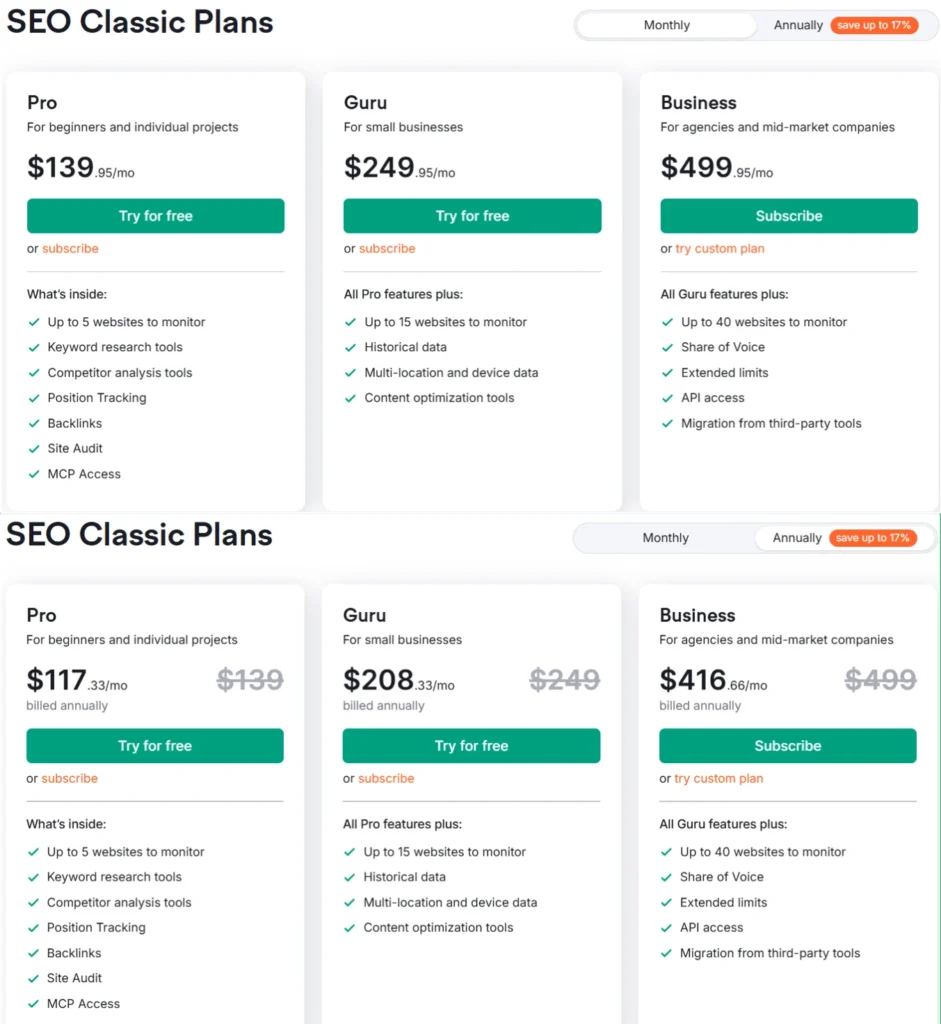
Pro is for freelancers and small site owners. You get 5 websites to monitor, 500 keywords to track daily, site audit up to 100,000 pages/month, 10,000 results per report, and 3,000 reports per day. No historical data. No multi-location tracking.
Guru is the sweet spot for most independent SEO professionals and small agencies. 15 websites, 1,500 daily keywords, historical data access, multi-location/device tracking, content optimization tools, and keyword cannibalization reports. Historical data alone is worth the jump from Pro if you’re doing serious competitor research.
Business makes sense for agencies handling multiple clients. 40 websites, 5,000 keywords, API access, Share of Voice, extended limits, and migration from third-party tools.
Annual billing saves you up to 17% — the difference between $139.95/mo and $117.33/mo on Pro adds up to roughly $270 saved over the year.
Semrush One Plans (New — Most Articles Miss This)
Semrush now also offers a separate plan family called Semrush One, positioned as the solution for traditional SEO + AI search + GEO. These are currently on introductory pricing.
| Plan | Monthly Price | Annual Price (per month) |
|---|---|---|
| Starter | $199/mo | $165.17/mo |
| Pro+ | $299/mo | $248.17/mo |
| Advanced | $549/mo | $455.67/mo |
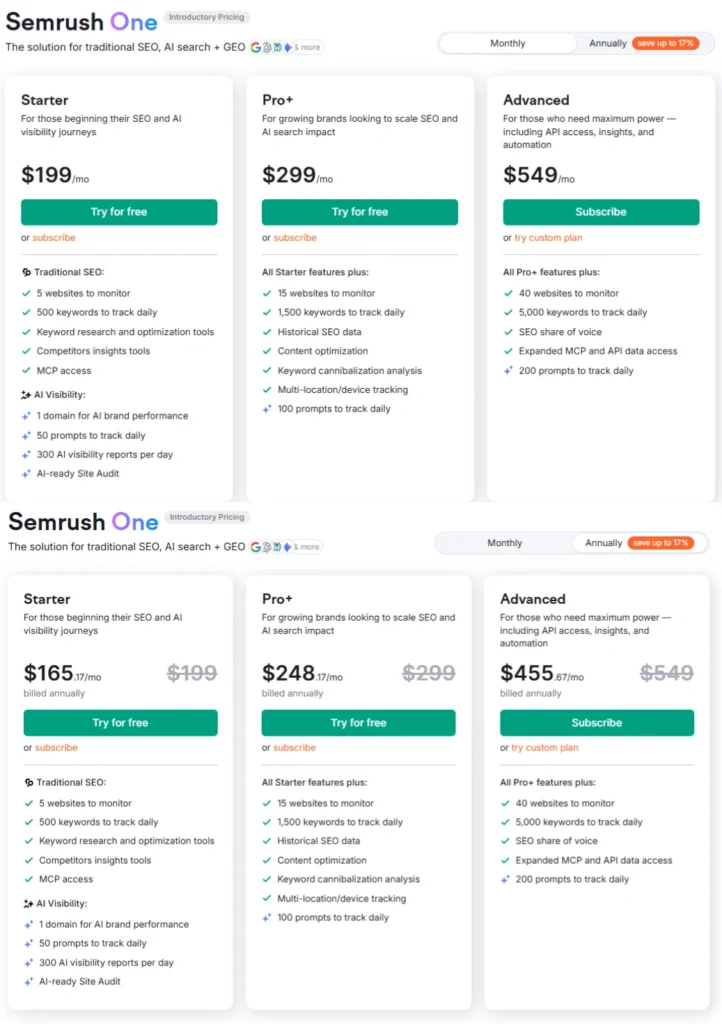
Starter includes 5 websites, 500 keywords to track daily, 1 domain for AI brand performance, 50 prompts to track daily, and 300 AI visibility reports per day.
Pro+ adds 15 websites, 1,500 keywords, historical SEO data, content optimization, keyword cannibalization analysis, multi-location/device tracking, and 100 prompts to track daily.
Advanced covers 40 websites, 5,000 keywords, SEO share of voice, expanded MCP and API data access, and 200 prompts to track daily.
The Semrush One plans are for teams that need both traditional SEO data AND AI visibility tracking in one place. If you’re only doing classic SEO, the SEO Classic plans are the more cost-effective choice.
Add-Ons That Inflate the Real Cost
This is the “hidden fees” part that most Semrush users discover after subscribing.
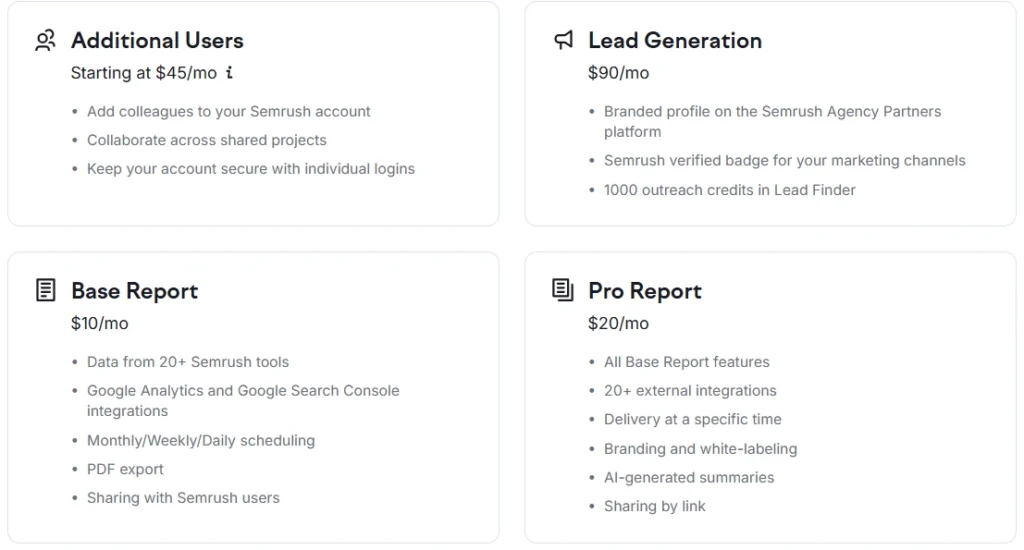
- Additional Users — starts at $45/month per user. Every plan, including the most expensive ones, comes with just 1 user seat by default. For agencies with 3–4 team members, this adds $135–180/month on top of the base plan.
- Lead Generation — $90/month. Adds a branded Agency Partners profile and 1,000 outreach credits in Lead Finder.
- Base Report — $10/month. Pulls data from 20+ Semrush tools, integrates Google Analytics and Search Console, and allows scheduled PDF exports.
- Pro Report — $20/month. Everything in Base Report plus white-labeling, branding, AI-generated summaries, and 20+ external integrations.
A real-world scenario: a small agency on the Guru plan with 2 extra users and Base Report is paying $208.33 + $90 + $10 = $308.33/month, not $208. That’s worth knowing before you commit.
The Real Reasons Semrush Charges This Much
1. Database Maintenance is Genuinely Expensive
Semrush’s keyword database alone contains billions of entries across 140+ countries. That data gets crawled, updated, and recrawled continuously. The infrastructure cost behind that is not trivial — and it directly explains why enterprise-grade data costs enterprise-grade pricing.
2. No Pricing Localization
Semrush prices in USD with no regional adjustments. Whether you’re in the US, India, Eastern Europe, or Latin America, you pay the same dollar amount. For markets with lower purchasing power (including India, where the INR/USD conversion makes $139.95 closer to ₹11,700/month), this hits much harder than it does for a US-based user.
This is one of the most common complaints in non-Western markets. It’s a legitimate frustration, not just sticker shock.
3. They’ve Moved Upmarket
This is something most people haven’t noticed. If you look at Semrush’s current pricing as a new user, the entry tier is now much higher than it used to be. The old $99/month plan is gone. They’ve quietly repositioned toward mid-size businesses and enterprise clients.
They’ve made a strategic bet: it’s more profitable to win 1,000 business accounts than 10,000 freelancer accounts with high churn. The product and pricing now reflect that.
The price reflects this shift. In 2025, the entry plan was $129.95/month. It’s now $139.95/month — a $10 increase that signals where Semrush sees its core customer base headed.
4. Brand Premium
Semrush is one of the most recognized names in SEO. When a marketing team needs to justify a tool purchase to management, “we use Semrush” gets approved faster than “we use [cheaper alternative].” That brand value has a real price built into it.
5. The Platform Effect
Replacing Semrush piecemeal would realistically require: a keyword tool, a rank tracker, a backlink tool, a site audit tool, a content optimizer, and now an AI visibility tracker. When you add up even budget alternatives for each, you’re close to — or over — Semrush’s price anyway.
Yes, It’s Expensive — But Run the Numbers First
$139.95/month sounds steep. It is, honestly. But before writing it off, consider what you’d need to replace it.
A basic SEO stack without Semrush looks something like this: a keyword research tool (~$30/month), a rank tracker (~$30/month), a backlink tool (~$50/month), a site audit tool (~$30/month), a content optimizer (~$20/month), and now an AI visibility tracker (~$50/month). That’s roughly $210/month — and you’re still jumping between six dashboards.
Semrush at $117.33/month annually puts all of that under one login.
That’s not me defending the price. That’s just the math.
The other thing worth knowing: Semrush offers a 7-day free trial on their Pro and Guru plans — and you can access the full platform during those 7 days. Every tool, every report, every feature. That’s enough time to run a complete site audit, a keyword gap analysis against your top competitor, and see whether the data quality justifies what they’re charging.
Try Semrush free for 7 days — no commitment until you’ve actually seen what you’re paying for.
Is Semrush Worth It? Honest Use-Case Breakdown
I’ve recommended Semrush to clients, and I’ve also told some clients to skip it. Here’s the real decision framework.
Worth it if:
- You’re managing SEO for 3+ websites simultaneously
- You need competitor backlink and keyword data regularly (not just once a quarter)
- You’re doing content at scale and need cannibalization + historical data
- You’re an agency billing clients — the per-project ROI easily covers the monthly cost
- You want AI search visibility tracking without adding another tool
Not worth it if:
- You run a single blog with under 50 pages and aren’t actively building links
- You only need keyword research occasionally — the free plan or a $29/month tool will do
- You’re a complete beginner who hasn’t published 10 articles yet
- Your budget is under $100/month, and you can’t commit to annual billing
When I was starting my first affiliate site, I used Semrush’s free plan for the first 6 months. I didn’t subscribe until I had enough content that I genuinely needed daily rank tracking and competitor gap analysis. Jumping in on day one would have been a waste of money.
Pros and Cons — No Sugarcoating
Pros
- One subscription covers what would otherwise be 6–8 separate tools
- The keyword database is among the largest available, more reliable at scale than most alternatives
- Historical data on Guru+ lets you spot ranking trends competitors can’t hide
- Semrush One adds AI visibility tracking — genuinely useful as Google and ChatGPT blur together
- Free trial available on Pro and Guru plans (no credit card needed for some entry options)
- MCP access is available even on entry plans for developers integrating SEO data into workflows
Cons
- $139.95/month entry price is genuinely steep for freelancers and small site owners
- Only 1 user seat per plan by default — additional users start at $45/month each, making the team use expensive fast
- No pricing localization — painful for non-USD markets
- Some features, like JavaScript rendering for Site Audit, require the Guru plan or above
- Historical data is locked behind Guru — a real limitation if you’re on Pro and doing competitor research
- The free plan has strict daily limits — 10 requests/day across most tools
Cheaper Alternatives Worth Considering
Semrush genuinely isn’t for everyone. If the price is the blocker, here’s an honest look at what each alternative actually costs and where it makes sense.
| Tool | Monthly Price | Annual Price (per mo) | Best For | Where It Falls Short vs Semrush |
|---|---|---|---|---|
| Ahrefs | Lite $129/mo | Lite $108/mo | Backlink analysis, content gaps | Reporting limits on Lite; no content optimization tools |
| SE Ranking | Core $129/mo | Core $103.20/mo | Rank tracking, small agencies | Smaller keyword database; no AI visibility features |
| Mangools | Basic $30.50/mo | Basic $18.85/mo | Keyword research, beginners | No site audit, no competitor intelligence depth |
| Ubersuggest | ₹1,135/mo (Individual) | ₹630.83/mo (Individual) | Solo bloggers, Indian market | Very limited backlink data; no historical data on base plan |
| Google Search Console | Free | Free | Your own site’s performance data | Zero competitor data |
Ahrefs starts at $129/month (or $108/month billed annually) and is genuinely the closest rival to Semrush for backlink research and content gap analysis. The Lite plan covers 5 projects, 750 tracked keywords, and 6 months of historical data — solid for freelancers who don’t need the full Semrush stack. If backlinks are your main focus, try Ahrefs — though at this price point, Semrush’s Pro plan at $117.33/month annually is worth comparing directly.
SE Ranking is one of the most underrated tools in this space. Core plan is $103.20/month annually — cheaper than Semrush Pro — and includes rank tracking across major search engines, unlimited keyword and competitor research, site audit, and Looker Studio/GA/GSC integrations. It also offers a free 14-day trial with no credit card required. For small agencies managing 5–10 clients, SE Ranking delivers most of what Semrush Pro does at a lower cost. Start SE Ranking’s free trial and test it properly before committing.
Mangools is the budget pick for solo bloggers and beginners. At $18.85/month billed annually, the Basic plan gives you 100 keyword research requests/day, 200 tracked keywords, rank tracking, SERP analysis, and 100k backlink checks/month. The AI Search Watcher PRO is now bundled in all plans — 500 prompts monitored across multiple LLMs. It won’t replace Semrush for deep competitor research, but for someone just starting, it’s the most affordable entry point. Check Mangools pricing.
Ubersuggest is worth mentioning specifically for the Indian market. Monthly pricing is in INR — Individual plan starts at ₹1,135/month, Business at ₹1,890/month. The lifetime deal (Individual at ₹11,350 one-time) is genuinely interesting if you want a budget tool with no recurring cost. Features include ChatGPT and Gemini integration in keyword research, site audit up to 1,000 page scans/domain, and 125 tracked keywords. The backlink data is limited, but for a solo Indian blogger on a tight budget, the lifetime plan is hard to argue with. See Ubersuggest plans.
The honest verdict: If you’re managing multiple sites seriously and need competitor data depth, none of these fully replace Semrush. But if you’re an early-stage or budget-constrained, SE Ranking is the closest functional alternative, and Mangools is the best pure value for keyword research beginners.
Is Semrush Too Expensive Compared to Profound?
This question keeps coming up in search — and the honest answer is that it’s comparing two different things.
Profound ($99/month billed yearly for Starter, $399/month for Growth) is not an SEO tool. It does one specific job: tracking how your brand appears in AI-generated answers across platforms like ChatGPT, Perplexity, Google AI Overviews, Gemini, Microsoft Copilot, Grok, and DeepSeek. The Starter plan covers ChatGPT tracking only, 50 prompts monitored, and 1 seat. Growth adds 100 prompts, 3 answer engines, 6 AEO-optimized articles per month, and 3 seats.
There’s no keyword research. No backlink analysis. No site audit. No rank tracking.
Semrush at $139.95/month does all of those things — plus its own AI visibility layer (50 prompts/day on Semrush One Starter, 300 AI visibility reports/day). It doesn’t go as deep as Profound on the pure AEO side, but it covers the full SEO stack alongside it.
| Feature | Semrush (Pro, $139.95/mo) | Profound (Starter, $99/mo billed yearly) |
|---|---|---|
| Keyword research | Full access | Not available |
| Backlink analysis | Full access | Not available |
| Site audit | Up to 100,000 pages/mo | Not available |
| Rank tracking | 500 keywords/day | Not available |
| AI visibility tracking | 50 prompts/day (Semrush One) | 50 prompts (ChatGPT only) |
| Answer engines covered | Limited (Semrush One plans) | ChatGPT only on Starter; 3 on Growth |
| AEO content generation | Not available | 6 articles/mo (Growth plan) |
| Starting price | $139.95/mo (monthly) | $99/mo (billed yearly only) |
The verdict: If your only goal is AI brand visibility tracking across multiple LLMs, Profound is purpose-built for that and goes deeper. If you need traditional SEO alongside some AI visibility coverage, Semrush covers both in one subscription. They solve different problems — most serious teams will eventually need both.
My Experience After 5+ Years of Use
I’ve used Semrush on my own affiliate sites and on client WordPress projects. The tool that gets opened most in my daily workflow is Position Tracking — seeing daily rank changes across target keywords on a client’s site tells me whether what I changed last week is working or not.
The feature that most people underuse is the Keyword Gap tool. On a client project last year, running a gap analysis against two competitors surfaced 40+ high-intent keywords the client wasn’t targeting at all. That alone generated enough content work to justify the subscription for months.
The frustration I genuinely have is the single-user seat. For any project with even one collaborator, you’re immediately paying an extra $45/month. That should be included in a $200+ plan.
Can You Try Before You Buy?
Yes — and this is important. Semrush offers a free trial on its Pro and Guru plans. Both the SEO Classic Pro/Guru plans and the Semrush One Starter/Pro+ plans show a “Try for free” button on the pricing page.
The free plan (no trial, permanent) also exists — but it limits you to 10 requests per day across most tools, which is enough to test but not enough for real work.
If you want to evaluate the platform properly, start with the free trial here and use the first week to run a full site audit and keyword gap analysis on your top competitor. That test alone will tell you whether the subscription makes sense for your situation.
What I’ve Learned After 5 Years of Using It
One thing worth mentioning — across the client projects I’ve worked on, the teams that got the most value from Semrush were the ones who actually acted on the data. A tool that surfaces 500 keyword opportunities is only worth its price if someone’s writing the content. If your bottleneck is execution, not information, a $30/month tool will serve you just as well.
Semrush’s value compounds over time. The longer you use it, the more historical data you accumulate, the sharper your competitor tracking becomes. It’s not a one-month purchase — it’s a long-term investment in your SEO infrastructure.

SEMrush Free Trial » 7 Days Full Access!
Frequently Asked Questions
Why did Semrush increase its prices?
Semrush has gradually moved upmarket, targeting mid-size businesses and agencies rather than individual freelancers. They’ve expanded the platform significantly — adding content tools, AI visibility features, and MCP integrations — which naturally increases the infrastructure cost. The old $99/month plan has been replaced by a higher entry point that reflects both the expanded feature set and the shift in target audience.
Is there a cheaper version of Semrush?
The most affordable paid entry is the SEO Classic Pro plan at $117.33/month billed annually. There’s also a permanent free plan with daily usage limits (10 requests/day on most tools). For budget-constrained users, tools like Mangools (~$29/month) or SE Ranking (~$44/month) offer solid alternatives for specific use cases.
Not hidden exactly, but easy to miss. Each plan comes with only 1 user seat — additional users start at $45/month each. If you want white-label reporting, that’s an extra $20/month (Pro Report add-on). Lead generation tools are $90/month extra. The base plan price rarely reflects what a small team actually ends up paying.
Is Semrush worth it for beginners?
Honestly, probably not at the full subscription price if you’re just starting. The free plan gives you enough to do basic keyword research and site audits. Once you’re consistently publishing content and need daily rank tracking or competitor gap analysis, then the paid plan starts making financial sense.
How does Semrush compare to Ahrefs in pricing?
Ahrefs’ entry plan (Lite) starts at $129/month billed monthly, or $108/month billed annually. That’s actually close to Semrush Pro’s $117.33/month annual rate. The real difference shows up in what you get: Ahrefs Lite gives you 5 projects, 750 tracked keywords, and 6 months of historical data. Semrush Pro gives you keyword research, site audit, on-page SEO tools, and competitor analysis in one place. For backlink-heavy work, Ahrefs is arguably stronger. For an all-in-one SEO workflow, Semrush covers more ground at a comparable price.
Can I pay for Semrush monthly without committing annually?
Yes. Monthly billing is available at $139.95/month for Pro, $249.95/month for Guru, and $499.95/month for Business. Annual billing saves up to 17% — Pro drops to $117.33/month billed annually.
Bottom Line
Semrush is expensive because it’s a full SEO and AI visibility platform — not a single tool. Whether that price is justified comes down to how intensively you use it and how many sites or clients you’re managing.
If you’re actively doing SEO for multiple websites or client projects, the math usually works out. The combination of keyword data, competitor intelligence, site auditing, and now AI search tracking in one interface replaces a stack that would cost as much or more to assemble separately.
If you’re a solo blogger with one site and a light publishing frequency, start with the free trial, test it for a week, then decide. Try Semrush here — no credit card required for the trial entry.
Don’t commit to an annual plan until you’ve confirmed that the features you actually need are available in the plan tier you’re considering.